
The Highest Reference
Why Systems Lose Meaning Before They Lose Motion
By Sean Hart
January 24, 2026
Modern systems rarely fail from lack of intelligence or effort; they fail because they no longer agree on what sits above them, a problem Wassily Kandinsky identified long before the language of systems thinking existed.
Kandinsky’s Structural Insight
Wassily Kandinsky was not arguing for belief as sentiment. He was arguing for orientation.
His spiritual pyramid functioned as a disciplined model of how any human system advances. At the top sat God, not as a comforting idea, but as a fixed highest reference, something that could not be optimized away, negotiated with, or redefined on demand.
Without that reference, Kandinsky believed, culture does not flatten gently. It disintegrates into imitation, noise, and circular motion.
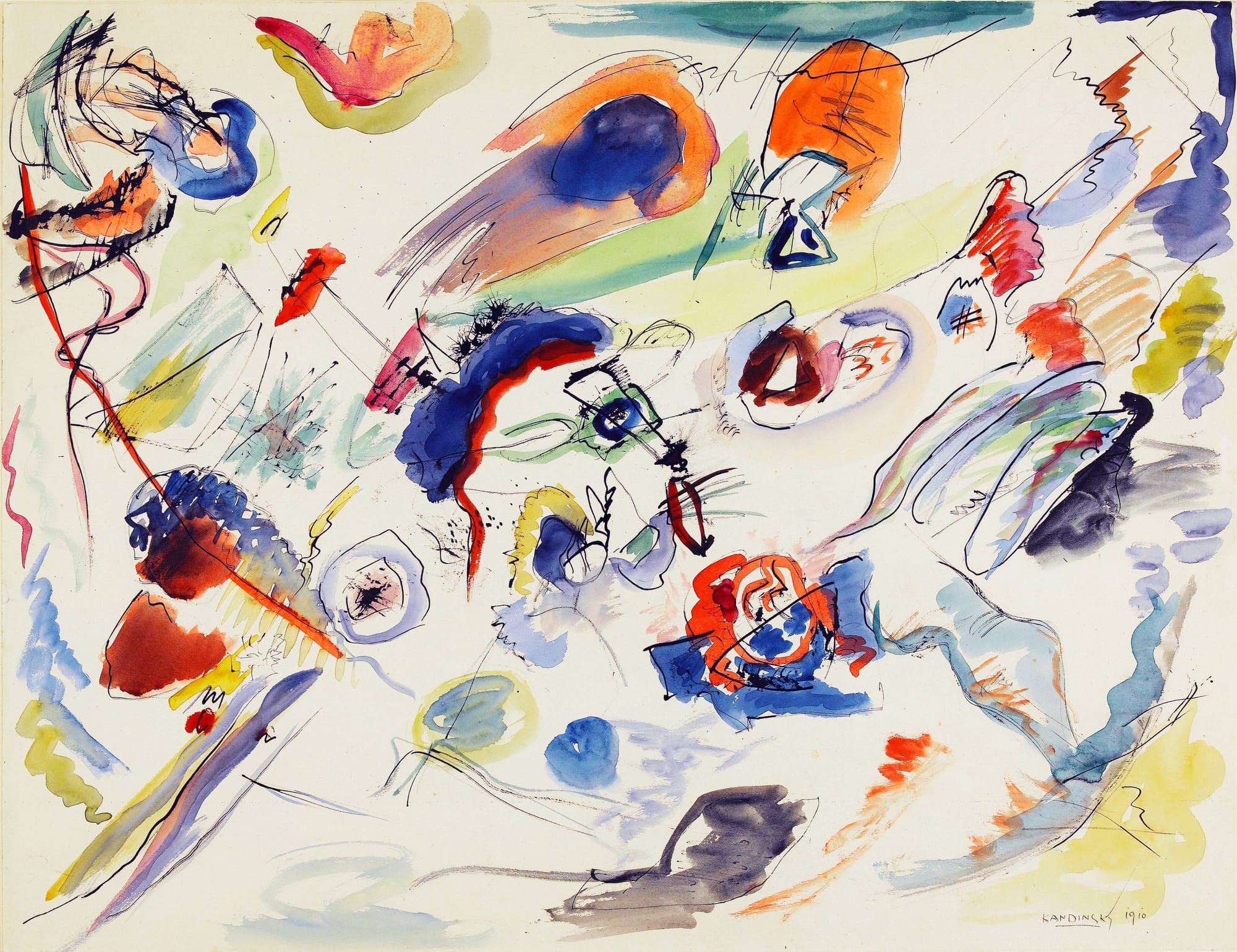
Kandinsky placed God at the top because progress, in his view, demanded allegiance to something beyond negotiation. That conviction marked the pinnacle of his career, when modern expressionism completed its ascent into abstraction. As a founder of the movement and an architect of its most decisive turn, he treated the correspondence between color and music as revelation. Chromesthesia was not technique, but output from a highest reference asserting itself through form.
Translating the Model Into Systems Language
In modern systems thinking, Kandinsky’s God maps cleanly to what can be described as a non negotiable reference constraint.
Not a KPI.
Not a mission statement.
A boundary condition that defines what progress even means.
Every resilient system has one.
- Science has falsifiability
- Law has legitimacy
- Markets have trust
- Medicine has patient welfare
When the highest reference is intact, disagreement sharpens the system. When it erodes, optimization replaces purpose.
The system stays busy. Direction quietly disappears.
Leadership and the Refusal to Name the Highest Reference
Many contemporary leaders claim neutrality while governing entirely through metrics.
This is not value free leadership. It is abdication disguised as objectivity.
When leaders refuse to articulate what sits above performance, three things follow with near mechanical certainty.
- Metrics acquire moral authority
- Alignment becomes compliance
- Vision degrades into branding language
Execution continues. Commitment thins. Culture becomes transactional.
Kandinsky would recognize this pattern immediately. The failure happens before results decline. It happens at the level of orientation.
Culture as Directional Pull
Healthy cultures do not coerce behavior. They create directional pull.
That pull exists only when something higher than comfort, popularity, or convenience is visible and costly.
In Kandinsky’s formulation, those closest to the highest reference experience friction first. They absorb misunderstanding so others do not have to yet.
Translated plainly, if no one is willing to pay a price for truth, the organization will eventually pay far more for confusion.
Cultures without a clear highest reference drift into performance.
Cultures with one become demanding, uneven, and durable.
Creative Work Beyond Self Expression
Much contemporary creative output is technically sophisticated and emotionally articulate, yet it often evaporates on contact with time.
This is not a failure of skill. It is a failure of obligation.
When creative work answers primarily to the self, it closes in on its own psychology. When it answers to something higher, it opens outward and outlives its maker.
Kandinsky’s abstraction was not rebellion against form. It was submission to an order he believed existed independently of taste, audience, or approval.
The work did not ask to be understood. It asked to be aligned.
Why Modern Systems Avoid Naming the Highest Reference
Explicit highest references create discomfort.
They force tradeoffs.
They expose hypocrisy.
They demand sacrifice without guaranteed reward.
Flat systems feel humane and flexible. They are also brittle.
What is often presented as post belief neutrality is more accurately belief by omission, with power, incentives, or social pressure quietly taking the vacant seat.
Kandinsky’s clarity was less dangerous than that pretense.
A Quiet Conclusion
Every system has something it ultimately serves.
The only real choice is whether that reference is explicit, defensible, and worthy of cost.
Kandinsky placed God at the top because he believed progress required orientation toward something that could not be negotiated with.
Remove that reference, and systems do not collapse.
They simply forget what rising was supposed to mean.
Sources and Intellectual Lineage
Primary texts by Wassily Kandinsky:
- Concerning the Spiritual in Art (1911)
- Point and Line to Plane (1926)
- Essays and letters collected in Complete Writings on Art
Contextual and systems oriented works:
- Sixten Ringbom, The Sounding Cosmos
- Peg Weiss, Kandinsky and Old Russia
- Donella Meadows, Thinking in Systems
- Niklas Luhmann, Social Systems
- Thomas Kuhn, The Structure of Scientific Revolutions
Image:
- Donation Mme Nina Kandinsky, 1976, CC0 License Wikipedia Commons
These works inform the historical grounding and conceptual translation. No passages are quoted directly, and all synthesis and language are original.